After a supplier is approved, shipment planning should connect the accepted product and lot to a documented delivery arrangement. Confirm the purchase revision, release evidence, delivery term and named place, customs information, packing, carrier schedule, and receiving plan. Clear owners for each handoff reduce the chance that a booking deadline or missing document becomes an unreviewed decision.
Key takeaways
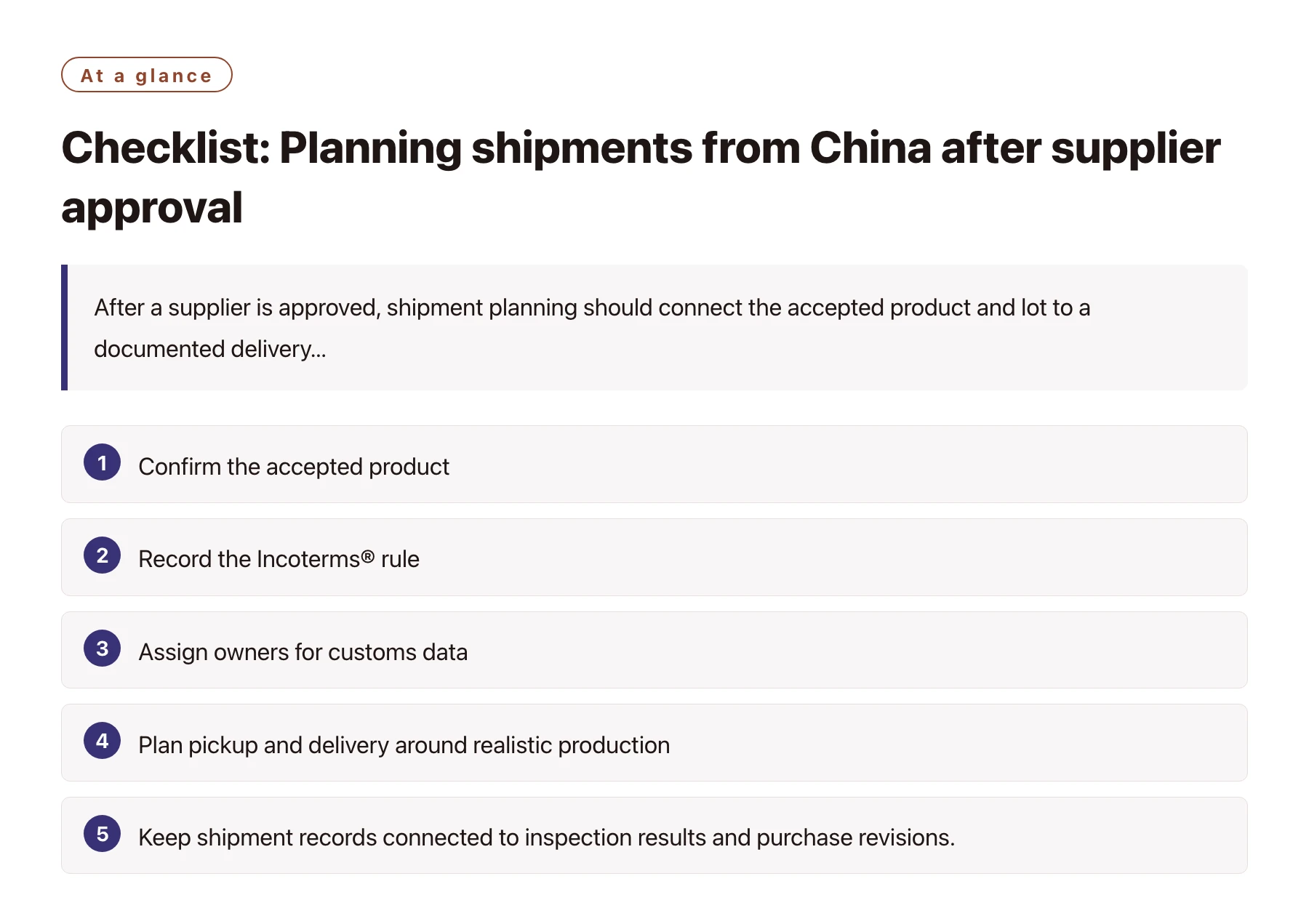
- Confirm the accepted product, lot, quantity, and shipment-release evidence.
- Record the Incoterms® rule, version, and named place in the commercial documents.
- Assign owners for customs data, transport documents, packaging, and cargo booking.
- Plan pickup and delivery around realistic production, carrier, and receiving milestones.
- Keep shipment records connected to inspection results and purchase revisions.
A shipment is the final chain of handoffs in a sourcing project. It should be planned from the approved order and the buyer’s receiving needs, with responsibilities clear before cargo is collected.
Confirm what “approved” covers
Supplier approval is a decision about a defined entity, product, site, and scope. Before shipment planning begins, verify that the approved quotation, product specification, sample revision, packaging, and purchase order agree. Confirm that any deviations are recorded and that open technical, quality, or regulatory decisions have an owner and due date. Approval of a supplier does not automatically release every product or lot it may manufacture.
Identify the lot and quantity planned for shipment. Ask the supplier to confirm production completion, inspection status, package count, weights and dimensions, shipping marks, and the earliest cargo-ready date. If the order contains multiple items or production lots, request a packing breakdown that lets the buyer connect each carton or pallet to the correct product and records.
Name the person authorized to release goods for booking. The release should rely on the evidence agreed in the purchase plan, such as inspection results, approved documents, and resolved deviations. If a required record is missing, decide whether shipment should wait or whether an authorized exception applies; do not let a booking deadline silently become acceptance.
Choose and document the delivery rule
An Incoterms® rule can allocate specified delivery tasks, costs, and risks between seller and buyer, but the named rule and place matter. The International Chamber of Commerce checklist compares buyer and seller responsibilities across Incoterms® 2020, including transport and insurance obligations.[1] Use the rule that matches the transaction and have the commercial parties confirm the exact version and named place in the contract or purchase documents.
Do not write only a three-letter code. Include the named port, terminal, warehouse, or delivery point and avoid mixing terms from different rules. Clarify who books main carriage, who handles export clearance, who arranges insurance where relevant, who pays destination charges, and who manages import clearance. Confirm the responsibilities against the actual contract, carrier arrangements, and applicable law.
Check whether the chosen rule fits the buyer’s operational capability. A buyer may need a broker, forwarder, or local representative to perform tasks allocated to it. If the seller offers a delivered price, confirm which costs and services it includes and where the seller’s responsibility ends. A trade term does not replace product acceptance conditions or payment protections.
Prepare accurate shipping and customs information
Before booking, reconcile commercial invoice details, packing list, purchase order, product descriptions, quantities, values, currency, origin information, and package identifiers. Ask who prepares each document and who checks it. Product descriptions should be precise enough for the parties and broker to identify the goods; inconsistent names and unit counts can create questions at handoff.
Identify the importer of record and customs broker, and confirm who will provide classification, valuation, origin, and permit information. These determinations depend on product and destination-market rules. Obtain advice from the responsible broker or compliance professional rather than copying a classification from a prior order without checking its applicability.
If the goods need special documentation, labeling, inspection, wood packaging treatment, or product-specific certificates, set the responsible party and delivery date before the cargo is collected. Make a checklist that ties each required document to a named order and lot. Keep copies in a shared folder with a clear revision and owner.
Protect the cargo and plan the physical handoff
Select packing for the product, route, handling mode, and expected storage conditions. Specify carton strength, internal protection, pallet configuration, moisture protection, shock or tilt indicators where justified, and marks needed for identification. Agree whether pallets must fit particular equipment or transport dimensions. Ask the supplier to photograph completed packing and verify that package counts match the final packing list.
Confirm cargo dimensions, gross and net weights, lifting points, stack limits, and any loading constraints. Coordinate the pickup window with factory access, warehouse capacity, carrier availability, and the buyer’s receiving hours. If cargo is consolidated with other orders, document how marks and documents distinguish each buyer’s goods and how custody changes are recorded.
Agree how damage, shortage, or document mismatch will be reported. Define the inspection at pickup or delivery, evidence to retain, reporting timeline, and escalation contact. Ask the carrier or forwarder which notices are required for a claim and keep photographs, package identifiers, and signed delivery records.
Build a realistic booking and milestone schedule
Work backward from the required delivery date and include production completion, final inspection, document preparation, cargo pickup, export handling, transit, destination release, and inland delivery. Transit time is an estimate and can change with routing, congestion, weather, or customs processing. Keep planned and actual dates separate so project teams can see where delay occurs.
Ask the forwarder for booking cutoffs and space confirmation, then coordinate them with the factory’s actual cargo-ready date. Confirm whether a booking is tentative or secured and what charges may apply if the goods miss the window. For a shipment that cannot split, reserve a schedule that includes time to correct packaging or documents before departure.
Use a shipment status log with milestone, planned date, actual date, owner, evidence, and next action. Escalate a missed milestone early, while there are options to revise collection, routing, or delivery expectations. Keep the buyer’s internal receiving and installation teams informed about any change that affects storage, labor, or project sequencing.
Close the order with a controlled document set
After departure, collect the final commercial and transport documents from the designated parties and compare them with the approved order. Check that package count, weight, consignee, product description, and references are consistent. Forward corrections through the proper issuer; do not edit an issued transport document informally or circulate conflicting versions as though both were final.
Keep the shipment file with supplier approvals, the purchase order, inspection evidence, invoices, packing list, transport documents, required certificates, release decision, and receipt record. A buyer should be able to trace a delivered carton to the relevant lot and production evidence if a quality question appears later.
For shipment coordination from China, a buyer may review Shanghai JS Sourcing as one support option. Confirm whether the requested scope includes booking, document collection, supplier follow-up, or only coordination, and keep customs decisions, cargo release, and final receiving responsibilities with their assigned owners.
Sources
Frequently asked questions
Does supplier approval automatically authorize shipment?
No. Confirm the approved product and lot, agreed inspection and document evidence, and the person authorized to release the goods under the purchase plan.
What details should accompany an Incoterms® rule?
State the rule, Incoterms® version, and precise named place in the relevant contract or order. Confirm the allocated tasks against actual carrier, broker, and import arrangements.
Who should decide customs classification and import requirements?
The importer and its qualified customs or compliance advisers should confirm the product-specific requirements for the destination market. Do not assume a prior order’s classification applies automatically.
Which records should be kept after a shipment leaves?
Retain the approved order, lot and inspection evidence, final invoice and packing list, transport documents, required certificates, release decision, and receiving record in one traceable shipment file.